
| Home | Office Bearers | Research Listings | Resources for Researchers | Research Recordings | Releases | Christian Art | Music Iconography | News & Events | Personalities | Product Gallery |
Posters are available in three sizes:
Description:
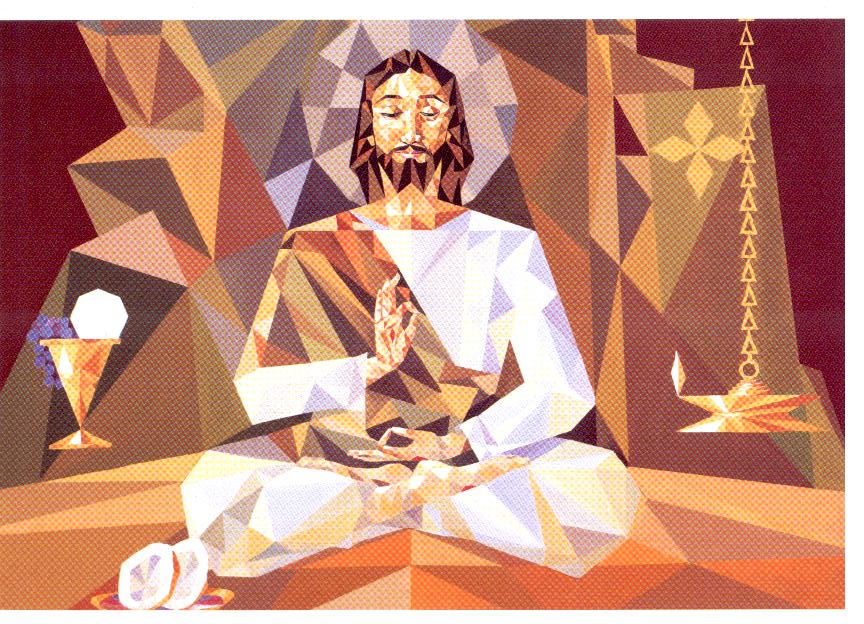
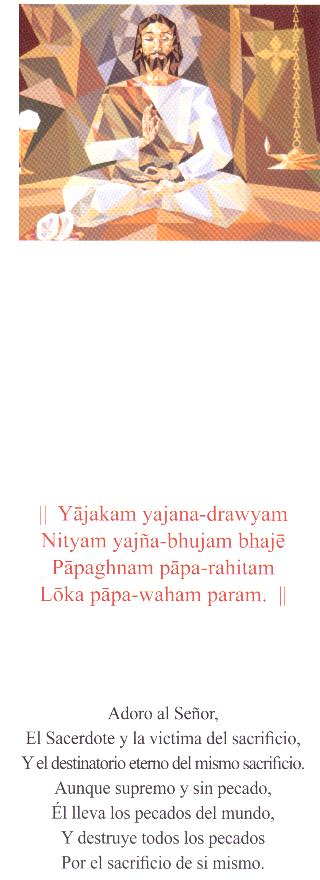
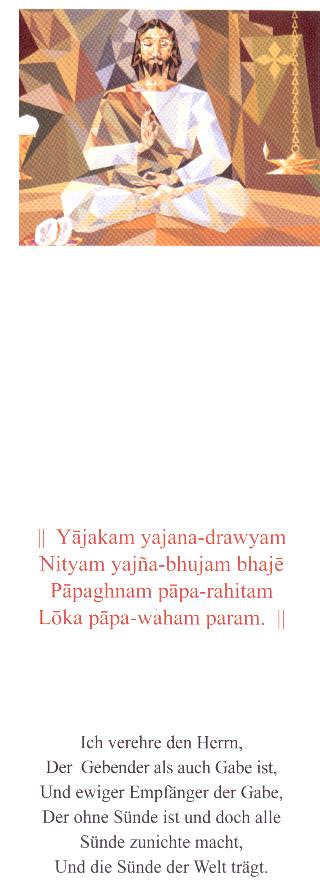
Joy Elamkunnapuzha drew the original design in 1977, and V. Balan executed
it in mosaic style on the facade of the Chapel at Dharmaram College in
Bangalore, India. Christ is presented here as a yogi in meditation under the
sacred peepal tree. He is seated in padmaasanam, the lotus posture. The
calm and compassionate look on the face depicts the image of the ideal guru
, spiritual teacher, in the Indian scriptures. The hand gestures show
jnaanamudra, the sign of imparting knowledge and wisdom that dispel
darkness (the Sanskrit term guru is a combination of gu, "darkness," and
ru, "that which dispels").
The red color on the hands and feet shows the nail marks from crucifixion.
They are the signs that St. Thomas, the Apostle of India insisted on as
proof of Jesus's resurrection (Jn 20: 24-29). The equal-armed cross is
presented in the form of a flower. The flame represents both Christ and the
devotee alike; it is a reminder of two complementary sayings of Jesus: "I am
the light of the world" (Jn 8:12) and "You are the light of the world" (Mt
5: 14). The two halves of a coconut, often placed at the forefront during
religious rituals in India, is a symbol of self-sacrifice. The chalice with
bread and grapes represents the sacrificial gift of Jesus in the holy
Eucharist.
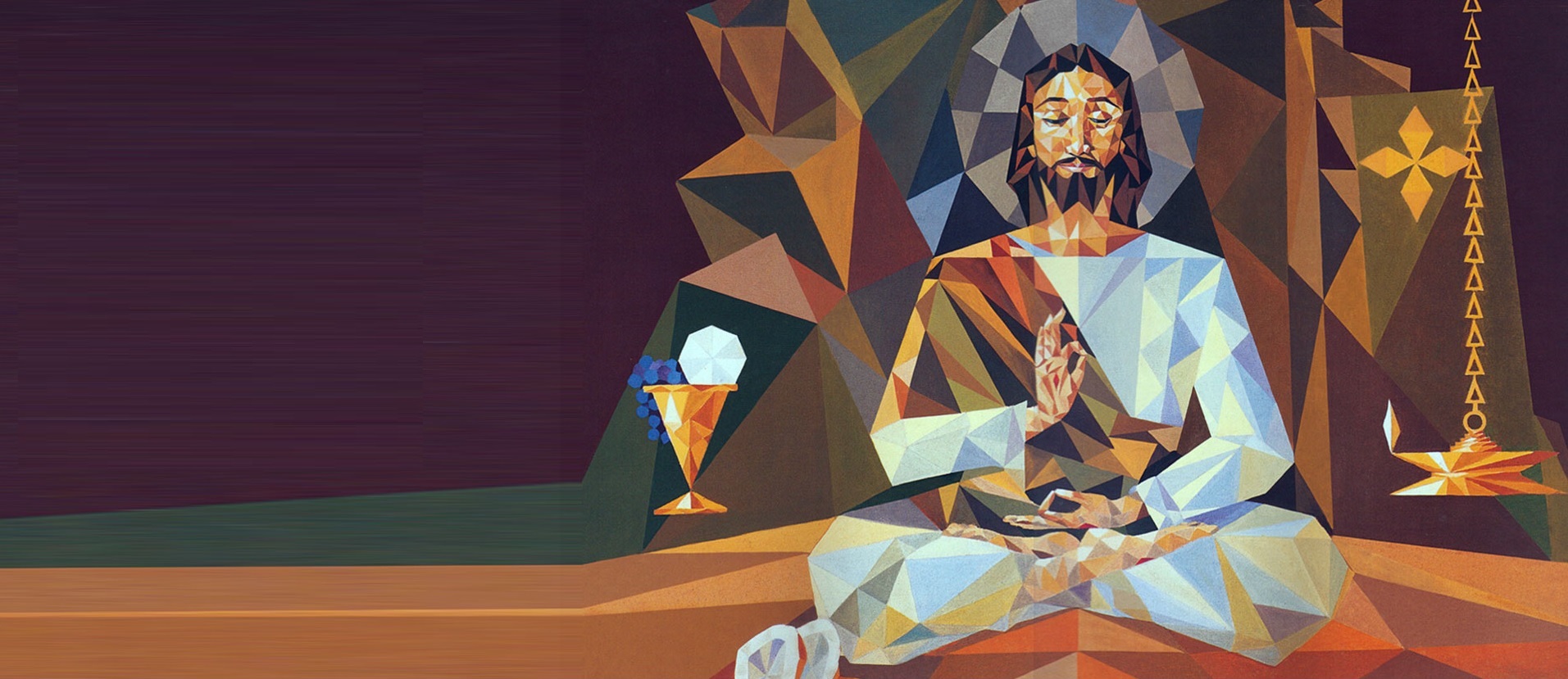
M. P. Manoj made this painting in 1993. Manoj made a few modifications in
the original design, including a different color scheme. The entire figure,
except the circular ring holding the lamp, is made of triangles, symbolizing
the Christian concept of God as a trinity of three persons. Instead of the
earthen lamp in the original, the flame here comes from a hanging oil lamp (
tuukku vilakku). This kind of lamp can be seen at traditional homes and
places of public worship, especially in Kerala.
-- Joseph J. Palackal
To purchase copies, please click here.
Posters: 17.75" x 10.25" / 45 cms x 26 cms.
Post cards
Note cards (blank inside) available in sets of 10 cards and 10 envelopes.
Christmas cards (in sets of 10 cards and 10 envelopes)
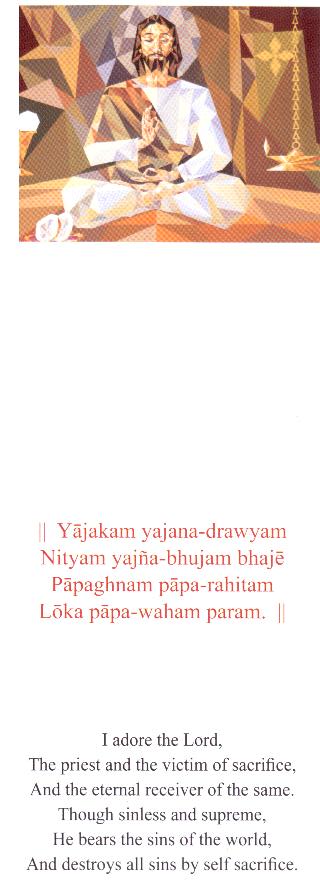
Bookmarks in English, Spanish, and German.
Description
Clad in a sari, the traditional Indian dress,
the Virgin presents her son, the Word incarnate, to the world. She
holds a lotus bud in her hand, but the son's gaze is on the devotees,
welcoming them with open arms. She stands on a pond with lotus
flowers; the lotus, the national flower of India, prefigures in the
ancient Sanskrit literature as a symbol of purity and seat of the
Supreme Being; rooted in mud and mundane realities, the flower remains
unstained and retains its resplendent beauty; similarly, by virtue of
the immaculate conception, the Virgin became a pure dwelling place for
the Divine Child. A peacock at the bottom left looks up in
expectation; the figure of the peacock, the national bird of India,
slowly transforms into multicolored rays of the sun; seven rays
originate from inside the halo. The crescent moon, weaving through the
rays, serves as a second halo to mother and son; it is a reminder of
the Virgin's role as the reflector of the light of Jesus. Multilayered
clouds in many hues merge with water, indicating the meeting of heaven
and earth, and divinity and humanity in the person of the infant
Jesus.
-- Joseph J. Palackal
To purchase copies, please click here.
Post cards
Christmas cards (in sets of 10 cards and 10 envelopes) Note cards (blank inside), available in packets of 10 cards and 10 envelopes.
To purchase copies, please click here.
Christmas cards (in sets of 10 cards and 10 envelopes)
To purchase copies, please click here.
Description
Shah Jahan (1592-1666), the fifth ruler of the Mughal Empire and the creator of the Taj Mahal, is riding upon his royal horse on the rugged banks of the river Jamuna. Taj Mahal is not built, yet. Following the Christian tradition introduced to the Mughal court by the Jesuit missionaries at the time of Akhbar, the Emperor appears like a saint with a halo around his head. Four angels, two on each side of the divine effulgence, descend from the heavenly clouds. The angel on the right counteracts the sharpness of the Emperor's spear with the sweetness of music flowing from the trumpet. The second angel on the right is putting the third necklace on the shoulder of the Emperor. The second angel on the left is offering a crown, and the angel at the extreme left is holding...
Not much is known about the painting. The unknown author singed at the bottom as `Amal Khurram', which literally means `work of Khurram'. Khurram (Persian, `Joyful') is the birth-name of Shah Jahan, given to him by his grandfather, Akhbar.
A painting of Shah Jahan in a similar style and probably from the same period, is at the Smithsonian Institution in Washington, D. C.; in that painting, the Emperor stands on a globe, with three angels appearing from the clouds, offering him a crown, canopy, and an ornamented sword.
The framed copy of this painting was given to me as a gift by Thomas Arena from New York, in March 2009. The copy was in his possession for over forty years. Mr. Arena could not recall from whom or where he bought the painting. If any one has more information on this painting or the whereabouts of the original work, kindly contact us.
-- Joseph J. Palackal